The Wonders of Wrangletown

Early
Life
Freshwater or Wrangletown is situated
between Eureka and Arcata. To get there you had to
cross dangerous
mountain paths or travel by boat over treacherous
waters. The
occupants came from France, Switzerland and New
Brunswick and last, but not least, New England and
the south.
Freshwater
got its name because the Eureka Slough was salty,
but the adjacent slough was fresh water, therefore
the valley got the name Freshwater. Wrangletown was
established
in the 1870's. Freshwater has been known by several
names over the years. It has been called Garfield,
after the
school district, Lambertville, after the Lambert
family, and Hardscrabble, after the fist fights. Wrangletown
is the name that has lasted the longest. The origin
of the name is not clear. It has been said that
two
Freshwater
women that were heads of their households were strong
willed and didn't fail to let their minds be known.
In the small community their paths crossed and
it was soon
the talk of the village that these two women couldn't
get together without getting into a physical confrontation.
This continued for as long as they lived in the village.
A passing stagecoach driver announced in public that
the place should be called Wrangletown.
Wrangletown
was cleared by the loggers and small cabins were
built around the store that is still
there today.
The town grew after several years to include hotels,
stables, a blacksmith, a restaurant, a bowling
alley, a tailor, a dance hall, a shoemaker, a barber,
a
butcher, a candy shop, two grocers, many saloons,
post office
and a school. By the middle of the 1880's Wrangletown
was a booming town.

Early Industries
There were
two main industries in early Wrangletown, logging
and farming. There was one large logging
business run by the Excelsior Company. This
logging industry employed
from 300 to 1,500 men at a time. There were
also several family operated mills run by George Pinkerton,
Tom Cloney
and several more up Graham Gulch and McCready
Gulch. The loggers had their work cut out for them.
The
average tree took about a day to fall, but
some
would take several
days to fall.
There
were also several farming operations at this time.
The largest obstacle for the
farmers
at first
was the
large tree stumps left behind by the loggers.
Some of the stumps were from five to twenty
feet in
diameter! Once the land was clear, the farmer's
efforts were
rewarded
from the rich soil they produced. Some farmers
grew hay, potatoes, corn, carrots, strawberries,
grapes,
and apples.
Many people had milking cows. Many of the
farm owners did not put up fences to keep the cattle
in. Once
in awhile a cow would wander off and the
owner
would have
to go look for her! Some people would go
around and deliver a quart of milk to each person.
John Spinas
had this
job. He worked for the Lambert's farm. There
was one lady that would accuse Mr. Spinas
of
not giving
her a
full quart of milk almost on a daily basis.
John would try to explain to the lady that his jar
was a quart size
and that he always filled it to the brim,
but she was never convinced.
The Hunting
Bear
A good hunter would usually have a good
hunting dog. A bobcat or a bear would be trapped and
used to train
the dog. Once, a large bear cub was trapped
several miles from Freshwater. Henry Anderson, Harry
Steinberg, Vic
Loquist and Ray Cole all went to bring the
bear
back to town for dog training. The men tied
the bear's
feet and carried it back to town. They carried
the bear behind
Hughes' blacksmith shop across the street from
the store. They put a horse collar on the bear
and chained
him to
a tree stump. Dave Dillon, anxious to begin
the training, went to get his dog. This particular
dog must have
been young, stupid, or both because it walked
right up to
the bear. The bear, no doubt, was in a very
bad
humor in his inhospitable circumstances. He
proceeded to
whack the dog a good one on the head sending
it howling all
the way home. From that point on, bear hunting
was not the dog's specialty. After that incident,
a
shepherd was
bringing his flock down from Kneeland to the
market. He was unaware that the bear was chained
up on
the hill and as the sheep approached, the bear
let out
a loud roar
and frightened all of the sheep. The shepherd
was left to look for all of his flock wondering
why
anyone would
chain a bear up in the middle of town. A few
days later, G. W. Hughes and some other men
took pity
on the bear
and set him free.

Garfield
School
By 1884 there were enough families in
Wrangletown to establish a school. This was the year
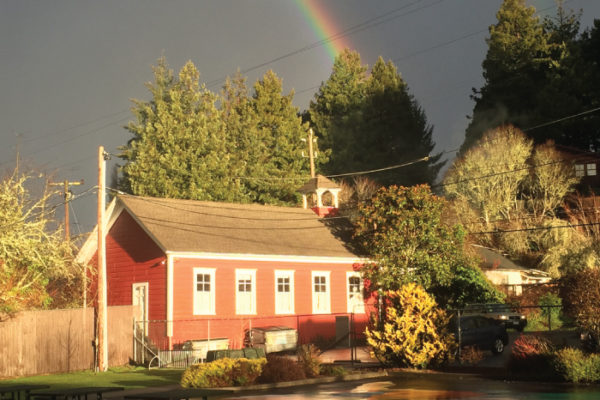
the Little Red
Schoolhouse was built and the beginning
of
Garfield School District. When the school
was first built
it had no paint
at all. When it finally was painted,
the school was painted white, not red! School was a
very important time. Many
of the families had come to California
from
Europe and had to learn English from
scratch. Classes
started
on
the first of August and ended May 25th.
School began at 9:00 AM and ended at 4:00 PM. The
only holidays
they had were Easter and Christmas. The
school had 30 to 70
students and one teacher to handle them
all. When it was time to go out or in to the school,
the boys
would
line up on one side and the girls would
line
up on the other side and go in. In 1904
the attendance had grown
so much that a larger, two-story, four
room school house was built for $3,450.00. The
larger two-room
schoolhouse
was eventually torn down in the 1970's and
sold for
scrap. The Little Red Schoolhouse still
remains and on April
23, 1994, the Little Red Schoolhouse
was dedicated as a historical landmark
by the
Native Sons
of the Golden
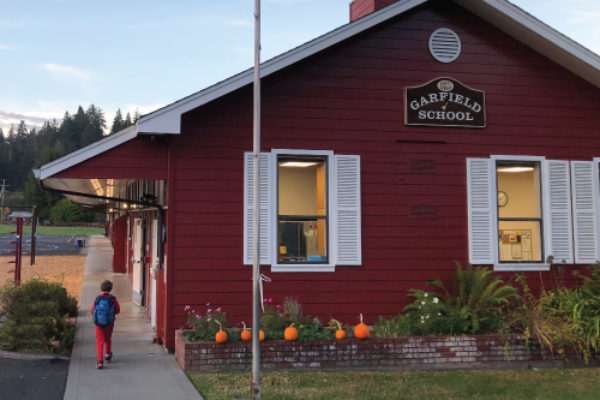
West. Today Garfield School has 51 students
attending and has three classrooms. The
rope is still pulled
each morning to ring the original bell
that calls the children
to school.
